




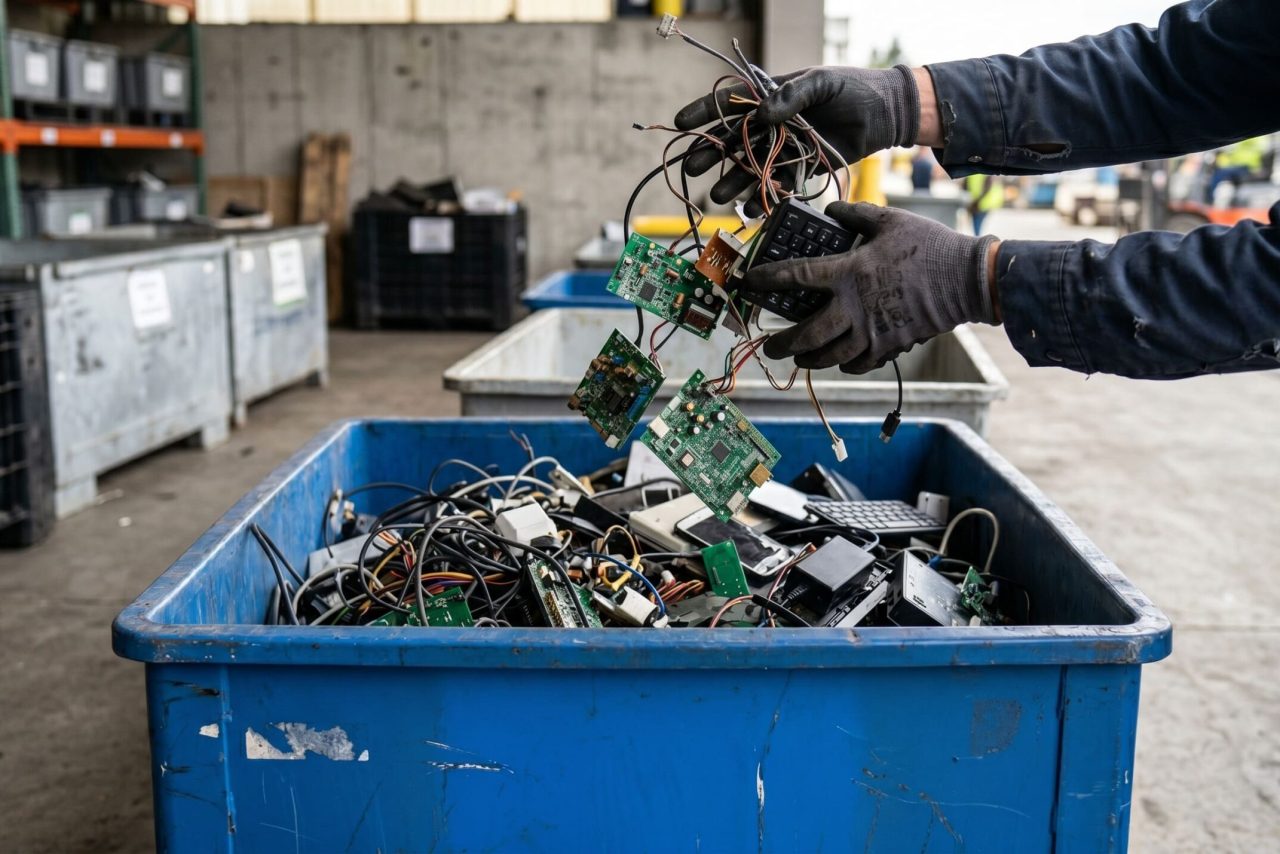
For decades, we have imagined mines as distant places, hidden underground. In the future, however, they could be found in our cities: in buildings, unused smartphones, spent batteries and end-of-life vehicles.
This is the principle behind urban mining: the recovery of critical raw materials from existing products and infrastructure. It is becoming increasingly important for Europe, which aims to reduce its dependence on imported materials essential to the energy and digital transitions.
Today, only 1% of the critical raw materials consumed in the European Union comes from recycling. This is why the Critical Raw Materials Act has set an ambitious target: by 2030, at least 25% of the EU’s consumption of strategic raw materials should be met through recycling.
The challenge involves materials essential to batteries, electricity grids, electric mobility, renewable energy and digital technologies: lithium, cobalt, nickel, copper and rare earth elements. Europe remains heavily dependent on suppliers outside the EU for these resources.
A potential worth millions of tonnes
According to the European FutuRaM project, by 2050 urban mining could enable the recovery of 4.1–5.7 million tonnes of critical raw materials per year, potentially covering up to 56% of Europe’s demand in the most favourable scenario.
However, much of this potential remains untapped. In 2022, approximately 5.2 million tonnes of critical raw materials were placed on the European market, but only 1.4 million tonnes were recovered. Household items also represent a strategic reserve: an estimated 700 million unused smartphones are stored in European homes, containing valuable amounts of copper, cobalt, lithium and rare earth elements.
The technologies mining our waste
New technologies will make this transformation possible. Artificial intelligence, computer vision, advanced sensors and robotics are improving the ability of recycling facilities to identify and separate complex materials. Digital Product Passports will also provide information on the composition and characteristics of products throughout their life cycle, making recovery and recycling easier.
Urban mining is therefore more than a circular economy practice: it is a new industrial strategy. The mines of the future may not lie underground, but in the objects we use every day — an urban reserve of materials that Europe can no longer afford to ignore.

